
I was 12-years-old the first time I fought with my dad about sports.
He grew up in rural Michigan, rose every day at 4 a.m. to head into his maintenance job for a General Motors parts supplier, and rarely missed a day until he became too physically weak to turn a wrench. He proudly boasted about his “shop rat” credentials any chance he got. His sports rooting interests reflected his humble work ethic. Though he never went to college himself, no team better reflected his values than Bo Schembechler’s “the team, the team, the team,” University of Michigan. I was raised watching Michigan football and basketball, rooting for an endless parade of athletes who, I was constantly reminded, were never bigger than the program.
Then, five talented freshmen arrived on Michigan’s campus in 1991, refusing to pay dues and unimpressed by the university’s manufactured mythology. Chris Webber, Jalen Rose, Juwan Howard, Jimmy King, and Ray Jackson had undeniable skill and style, mainstreaming the baggy shorts and black socks look that had been popular for years on city courts into the halls of pasty white suburban middle schools like mine. Their play was flashy, with off-the-charts athleticism paired with a gleeful willingness to celebrate every play they made. They violated everything my dad tried to teach me about sports, that stars should be humble, that showboats always get comeuppance, that basketball teams that don’t run structured offenses will never beat regimented, disciplined teams. It is too simplistic and not really accurate to say my dad hated them — they played for his favorite team, after all, and he was loyal. But he was never comfortable with their style, with their willingness to speak their minds from the moment they showed up on campus, with their blackness. He was definitely not comfortable with how much I loved them.
In 1993, I watched every second of Michigan’s season I could, prepared for the Fab Five to win a National Championship. My dad watched with me, also hoping for a championship but never missing an opportunity to question whether Webber’s ego was getting too big, or whether he was thinking too much about leaving for the NBA, or whether Rose was too much of a “ball hog” to be an effective point guard, or whether Steve Fisher should be a more forceful disciplinarian “like Bo would be.”
Webber played beautifully in the championship game until, in a flash, his narrative was forever changed. Webber ensnared a rebound with :20 seconds remaining and Michigan down two points, the last moment in that game that he looked like the swaggering, once-in-a-generation basketball machine he had been for two years at Michigan. First, he traveled. But he didn’t just travel. One of the most instinctive, gifted players at any level of basketball looked unsure of what to do with the ball. He looked like he was trying to pass, then changed his mind and dragged his feet. The referees didn’t call it, and Webber clumsily and frenetically began dribbling. He advanced the ball himself, but then dribbled directly into a trap by two North Carolina defenders. His basketball instincts suddenly returned, and he did something most basketball players do to save a possession under immense defensive pressure — he called timeout. Michigan didn’t have any. Referees awarded North Carolina technical foul free throws and possession of the ball. The game was over, and Webber produced an iconic sports mistake that will outlast his Hall of Fame-worthy career accomplishments.
My dad pounced. “See, he was trying to do it all himself! He should’ve passed to Jalen! He wanted all the glory!” I’d watched Webber sullenly walk off the court, clearly near tears, his once joyful eyes blankly staring in the distance. For the first time in my life, sports made me cry. I couldn’t listen to my dad. I shouted something incomprehensible at him as I stormed to my room, closed the door, and bawled. He didn’t understand why I was mad. It was just sports. Honestly, I couldn’t even explain why I was mad. But for the first time in my life, I was seeing humanity in the people playing the sports I loved, and that humanity seemed more important to me than the result of the game. My dad couldn’t figure out why a game occupied any of my thoughts after it ended. I was angry that my dad wasn’t worried about whether or not Chris Webber was okay.
***
Although he never would’ve articulated it this way himself, my dad’s childhood indoctrination of me into sports fandom had a central theme: playing college or professional sports is a privilege. The responsibilities that come with it include never calling unnecessary attention to yourself or seeking personal glory at the expense of the team; never showing weakness or pain; certainly never pointing to unfairness or structural inequities that are inherent in high-level sports.
Sports gospel in my house was most easily explained through Barry Sanders – my dad was far more impressed with the emotionless way Sanders tossed the ball to an official after scoring than with the otherworldly athletic feats that propelled him to the end zone. I blindly accepted that thinking, mostly. Until my mom got me a subscription to Sports Illustrated as a gift near the end of my freshman year of high school.
I got the first issue in June of 1995. It had a teenager on the cover — someone only a few years older than me — who I’d never seen before. He was wearing a blue and white track suit, but seated sideways in a way that made it impossible tell what brand. He was holding a worn basketball that had clearly been abused by blacktop before, and posed in a way that could’ve been a senior portrait. It was Kevin Garnett, before he’d achieved anything professionally, when his legacy was already a topic of debate in sports media before he’d even played a game.
Garnett was attempting to become the first player since 1975 to enter the NBA straight out of high school, skipping what I had always assumed was a required step of going to college first. My dad, unsurprisingly, was skeptical. Garnett was too young, too physically immature to face fully developed grown men. Who was going to babysit this teenager? Mostly, dad was just mad at Garnett’s audacity to defy convention — how dare he skip college? Everyone went to college! Didn’t he know the value of the free education he was turning down? That particular line of reasoning was extra funny in hindsight — my dad never went to college, and likely would’ve hated it if he had gone considering he’d never had a remote interest in anything resembling academia.

Jack McCallum’s cover story humanized Garnett for me, a rural white kid who didn’t even have cable television and learned to shoot on a makeshift court in a barn, slipping on hay and having to adjust the arc on my shot to account for a huge beam that was only about two feet taller than the basket roughly above where the free throw line would’ve been on a real court.
I couldn’t view athletes on TV as robotic entertainers anymore. I saw and questioned my own privilege. I grew up poor, but I still went to a good public school strictly because of where I was born. I didn’t fear violent crime in my trailer park. I didn’t fear the police. Even though college was expensive, I knew I could still go. My parents were divorced, but both were prominent, largely positive influences in my life. Many of the athletes I loved watching grew up in environments that were immensely more difficult than my own. To impose the values or standards of my family or community on them suddenly and definitively felt immoral.
***
As a parent who wanted to embrace my son Oliver’s love of sports but also provide him with the tools to find balance, humanity, and context in his fandom, I also turned to Sports Illustrated. Oliver stalks our mailbox each month, obsessing over when the next issue of SI Kids is going to arrive and who will be on the cover.
The subscription has sparked thoughtfulness in him. He’s taken an active interest in women’s sports as a result of the coverage it gets in his magazines. He was engrossed with the World Cup tournament and the U.S. Women’s Soccer Team. We watched and followed this year’s WNBA Playoffs together, and he learned and asked questions about the league’s top players after reading about them. His younger sister Isla recently started gymnastics, and he was ecstatic when the poster in one of his recent issues featured Symone Biles. He asked if we could frame it for Isla.
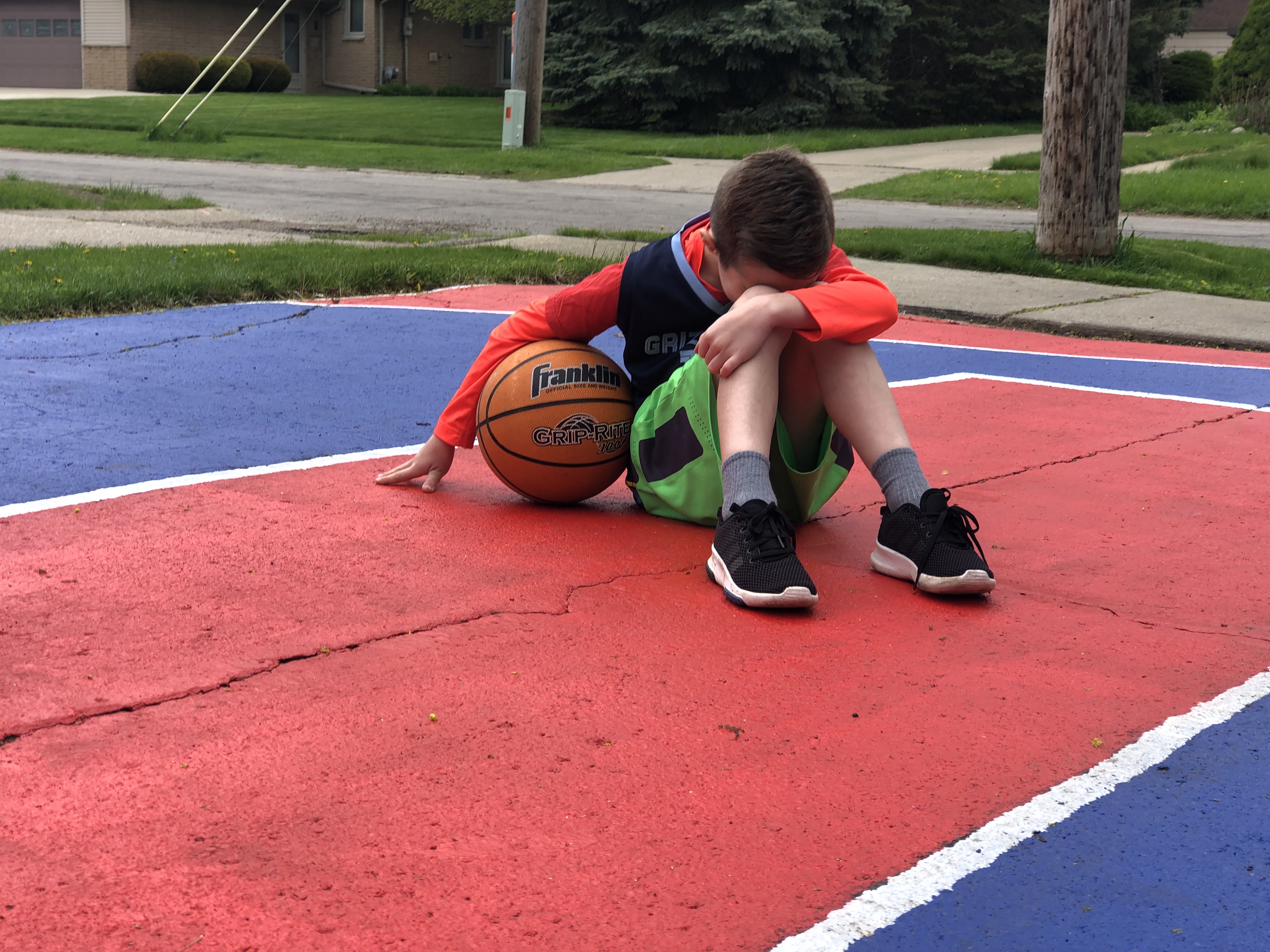
It has also helped Oliver understand some of the hypocrisies inherent in major college sports. The concept that individual players he roots for make massive amounts of money for the universities they play for and deserve to be compensated isn’t lost on him, even at only 10-years old. He constantly asks which pro teams his favorite college stars will play for.
***
My dad died in 2009 at 53 because of a confluence of health problems resulting from years of his beloved “shop rat” lifestyle — chain smoking, using alcohol to self-medicate, and chronic pain from a lifetime of backbreaking manual labor. We fought about sports all the time, and I got better at arguing my viewpoint after tearfully screaming incoherent words at him in defense of Chris Webber.
He was barely old enough (born in 1956) to be able to say the Detroit Lions had won an NFL championship in his lifetime (they last won in 1957, the pre-Super Bowl era). He also lived long enough to see the Lions become the first-ever team to go 0-16 in a season in 2008-09. I was a sports writer for the Flint Journal at the time, and when it became apparent the Lions had a real shot at a winless season, I began a weekly column rooting for the team’s demise in each game. After all, they were a really bad team no matter what, right? Wouldn’t it be better to be immortal than just a forgettable conventionally bad team?
“You’re an asshole for writing that,” he’d say to me, laughing and shaking his head. Our relationship had ups and downs. We were really different people. He worked with his hands, fixed things, and hated complexity. I was bookish, uninterested in working on cars in his smoky garage, and obsess over the real and imagined intricacies of why people are the way they are.
My dad lived with pain his entire life — physical pain from his job, emotional pain from tragic losses of people he loved, and depression and anxiety that he flat out refused to seek help for. Strong men don’t need help. That’s what he believed. I could never question it as a kid, and certainly not as an adult when my awareness of his struggles heightened. We couldn’t talk about it.
But we could talk about sports. We gained new understanding of each other’s personalities, senses of humor, concepts of right and wrong, even if we rarely agreed. He wanted to hate Rasheed Wallace when the Detroit Pistons traded for him before winning the 2004 NBA Championship based solely on Wallace’s overly negative portrayal in media from his time with Portland. When I reminded him that he used to adore another Piston center who shot three-pointers and got technical fouls, Bill Laimbeer, he quickly came around and usually laughed at ‘Sheed’s penchant for theatrically arguing with referees. And, even though I always gravitate toward loudmouths with colorful personalities, he helped me appreciate the athletes who just show up and consistently do a job. Loudmouths are fun, but sports don’t work if you have only loudmouths.
Oliver was born nearly a year to the day after my dad died, so they never met. Sports help me feel dad’s presence frequently, though.
Those moments when Oliver’s engrossed in a game, or asking dozens of rapid fire questions because he’s obsessed with a topic in the unique way that only kids can obsess and needs you to drop everything and answer RIGHT NOW, make me remember my dad’s patience when I’d similarly bombard him. I don’t want to force Oliver to watch sports the same way that I do. But I do want sports to be a vehicle for him to obtain curiosities about the greater world around him. I’m more aware of racism, of white supremacy, of poverty, of misogyny, of environmental racism, of a myriad of other societal and cultural issues, because of sports. I want him to find those things, too.
The greatest gift sports gave me as a kid was a way to get comfortable challenging an adult, and the greatest gift my dad gave me was the ability to argue with and challenge him in a space that was safe, that allowed me to build confidence, and speak up passionately for things I believed in without punishment or judgement, even when he thought I was a smartass. I hope sports allows me to provide those same gifts to Oliver.
When Oliver got to pick out a basketball jersey for his eighth birthday, he picked Ben Simmons. I got it for him, but not without a few, “He’s supposed to be a guard but he can’t even shoot!” digs. Oliver quickly responded, “Daddy, not everyone has to play basketball the same way. He’s fun to watch!”
I’m positive my dad would’ve been on my side regarding Simmons’ lack of shooting range. I also have no doubt he’d have adored his grandson pointing out my own lack of imagination.


Leave a Reply